What Wood Is Best for Plantation Shutters?

When shopping around for plantation shutters, you’ve no doubt wondered about the different materials available for this window treatment. Plantation shutters add beauty, value, ambiance, and privacy to any home and are a worthwhile investment, but like any investment, you want to make sure that you’re getting the absolute best in quality. While shutters are available in a variety of materials, options like vinyl and faux wood plantation shutters simply can’t compare to the authenticity that is found in all-wood plantation shutters. Plantation shutters made from other materials, even plantation shutters found at places like Lowe’s, are all made to look like the wooden plantation shutters that you can get at Shenandoah Shutters, because wood provides the highest value with unmatched beauty and durability.

But, the question then remains, what kind of wood is best for plantation shutters? What woods are the most commonly used? Here’s a closer look at the types of wood most commonly used for plantation shutters and how they affect the quality of your window treatment.

Basswood: Ideal for Stained Plantation Shutters

Basswood is one of those rare woods that manages to combine strength and durability with a resistance to moisture and a natural lightness that makes it an excellent choice for the handcrafted, custom plantation shutters of Shenandoah Shutters. Thanks to its almost completely uniform color, basswood is just the right material for stained interior shutters, a favorite among the elegant homes found throughout our service areas.

Stained interior plantation shutters give your home that optimal, natural wood feel along with all of the benefits that you love about plantation shutters. Stained shutters pair beautifully with the other fine wooden furniture within your home, especially when topped with our silken lacquer finish. Plus, the stain of your basswood plantation shutter will only grow richer and more in depth over time, creating a powerfully beautiful shutter.

Basswood is actually a term used to describe a variety of tree species, but you’ll likely know it best as the American basswood. Different types of American basswood — from Carolina basswood to white basswood — can be found in different regions of the United States. This is an incredibly fast growing tree, so Basswood is also considered a renewable resource. With a basswood plantation shutter, you can feel good about how your plantation shutters affect the environment. We even craft your basswood shutters close to home in our Richmond, Virginia workshop.

Yellow Poplar: Perfect for Cream Plantation Shutters

Yellow poplar is like the sister of basswood in that it has the same durability and lightness that makes it an ideal plantation shutter material, but is unique in that the color of yellow poplar wood isn’t a uniform color. In fact, yellow poplar is typically a blend of colors like white, yellow, and even green. It is this difference that makes basswood a better choice for stained interior plantation shutters, but allows yellow poplar to really shine as a cream or white plantation shutter. Just like with basswood, you might also find that some of your furniture or even the trimming in parts of your home is made of yellow poplar hardwood.

Interestingly, yellow poplar is not actually a poplar variety of tree, but is instead considered to be a part of the magnolia family of trees. Also known as a tulip poplar, thanks to its characteristic tulip-shaped leaves, it’s a tall tree that is also found throughout the United States, particularly in the Eastern United States.

Shenandoah Shutters is proud to use only American woods in our plantation shutters.

What About Specialty Woods Like Cherry or Oak?

Many people enjoy the qualities of specific woods. Hardwoods like cherry, oak, mahogany, and walnut are beautiful woods that are frequently found in your finest furniture pieces. They can certainly enhance your home as plantation shutter materials and add their own unique elements to your plantation shutters. However, it’s important to note that woods outside of the more commonly used basswood and yellow poplar woods can sometimes be heavier, which requires more intensive installation. These woods also each have their own color variations which will impact your stain or color.

Shenandoah Shutters often has customers request specialty woods outside of basswood and yellow poplar. Our craftsmen have decades of woodworking experience, and will build a stunning plantation shutter out of your chosen material. We offer a free, in-home design consultation that will give you time to discuss the best options for your home.

Does the Style of Wood Affect Maintenance?

With all of our plantation shutters, regardless of the type of wood, you can use a simple, soft cloth to clean the hardwood. Alternatively, you can use a duster or a vacuum attachment. Because Shenandoah Shutters uses authentic wood, you’ll want to avoid using water or chemicals to clean your plantation shutters, as this can lead to warping and damage. If you would really like to use a furniture polish, be sure to use a polish that is gentle and safe for use on your wooden shutters. The really great thing about a hard window treatment like plantation shutters, though, is how much easier it is to clean when compared to other window treatments.

From Basswood to Yellow Poplar and Beyond, We’ll Craft Your Shutter for You

At Shenandoah Shutters, you can feel confident that no matter the wood material, your plantation shutters are carefully crafted to beautifully outfit your individual home. Since we specialize in only all-wood, interior plantation shutters, you can rest assured that your window treatment will receive our complete focus, attention, and expertise. You can choose a traditional plantation shutter style, a café shutter that only covers the bottom of your window, or even our original, patented Softedge design that conceals the hinges of your plantation shutters once closed, lending even more beauty to your windows. From your questions about wood choices and design to concerns about coordinating any existing window treatments, send us a message online or give us a call today to discuss your needs for your custom built plantation shutters.

Frequently Asked Questions

  • What is the best wood for plantation shutters? 

Basswood and yellow poplar are the two most widely used and best-performing woods for plantation shutters. Basswood is ideal for stained shutters thanks to its uniform color, while yellow poplar’s natural color variation makes it a great fit for cream or white painted finishes. Both are lightweight, durable, and moisture-resistant.

  • Is real wood better than vinyl or faux wood for plantation shutters? 

For indoor use, solid wood offers the highest quality, beauty, and value. Vinyl and faux wood options are designed to mimic the appearance of real wood but can’t match the craftsmanship, authenticity, or long-term appeal of all-wood shutters.

  • Are Shenandoah Shutters’ woods sustainably sourced? 

Yes. Both basswood and yellow poplar are American-grown woods. Basswood in particular is a fast-growing tree, making it a renewable resource. Shenandoah Shutters also crafts their shutters locally in their Richmond, Virginia workshop.

  • How do I clean and maintain wood plantation shutters? 

Wood plantation shutters are easy to maintain. Use a soft cloth, duster, or vacuum attachment for regular cleaning. Avoid water and harsh chemicals, as these can warp or damage the wood. If you’d like to use a polish, choose one that is gentle and formulated for wood surfaces.

  • How do I know which wood is right for my home? 

The best way to decide is through a free in-home design consultation. Shenandoah Shutters’ team can walk you through wood choices, finishes, and styles based on your existing décor, lighting, and preferences.

Plantation Shutters vs. Other Window Treatments

Plantation Shutters vs. Other Window Treatments

Deciding how to dress your windows is one of the first topics that comes up after a home purchase. If the home you purchased already has a treatment, like blinds, you may have found yourself wondering if your existing window treatment is providing you with the best in appearance, maintenance, and home value.

When choosing from window treatment ideas, you can choose from what is known as a hard or soft window treatment. Hard window treatments include blinds, shutters, and most types of shades, while soft window treatments include curtains, valances, and drapes. Within each category, there are different types of each treatment. There are many different types of curtains, for instance, as well as many different types of blinds, shades, drapes, and shutters.

What Exactly Are Plantation Shutters?

Plantation shutters are hard window treatments that have been around for centuries, treasured for their ability to block out light, thereby controlling temperature and providing a form of insulation. These days, plantation shutters are also valued for their privacy, ambiance, and status as a permanent, sophisticated window treatment. Being a beautiful, permanent window dressing is what makes plantation shutters increase the resale value of every home that has this window treatment.

Plantation shutters come in a variety of materials and forms. The traditional plantation shutter is all-wood, with panels that extend from the top to the bottom of a window. This look remains classic and timeless, but there are now even more plantation shutter design options, including combining soft and hard treatments through the use of a café shutter for the lower half of the window and a valance to outfit the top. The movement of all plantation shutters is controlled using the tilt rod, which moves the louvers that beautifully filter sunlight.

Shenandoah Shutters offers a new option for plantation shutters — the patented Softedge design. With the Softedge design, installing plantation shutters in tilt-ins or casements is no longer difficult. Instead, the Softedge conceals the hinges, giving your home the harmonious appearance that you want and expect from plantation shutters.

Which is Best: Faux Wood, Vinyl, or All-Wood Plantation Shutters?

Vinyl plantation shutters and faux wood plantation shutters are less expensive than wood plantation shutters, but the quality of the all-wood plantation shutter is simply unmatched by any other type of shutter. All-wood plantation shutters are by far the most popular type of plantation shutter thanks to their natural beauty, old school charm, and structural integrity. Vinyl, faux wood, and plantation shutters made from other materials are all designed to look like all-wood plantation shutters. So, while you might pay a little more for wooden plantation shutters, you’re actually paying for the real thing. The  gorgeous end result of your investment is absolutely worth every penny.  

When you purchase custom made, all-wood plantation shutters at Shenandoah Shutters, every shutter is sanded by hand in our Richmond woodshop by skilled woodworking experts. Our design consultants work with you to determine the right paint, stain, or specialty wood to match your moulding. The entire experience of buying these all-wood window shutters is simply beyond comparison. Every step of the process is designed to provide you with the optimal window treatment.

Plantation Shutters Vs. Curtains, Drapes, and Fabric Window Coverings

Curtains, drapes, valances, and other fabric window coverings are familiar window treatments. Many households combine soft treatments like curtains with other window treatments, like blinds or specific types of shutters (as in the café shutter). The cost and quality of curtains depends greatly on the type of fabric used, as well as the amount of material. While plenty of curtains add style and color to a room and help block out sunlight, you don’t get any light control with these soft window treatments.

With plantation shutters, you’re in total control as you adjust the louvers to let in just the right amount of light for your needs. With soft window treatments, you’ll spend a great deal of time washing the fabric, which can easily tear or stain and won’t last as long as a hard window treatment. Hard window treatments, particularly all-wood plantation shutters, are easier to clean, often simply requiring a dusting cloth every so often. If you spill a drink on a curtain, your curtain may never look quite the same way again. Splatter a drink on your plantation shutters? Just wipe it down with a soft cloth.

Soft window treatments can be wonderful choices when you need to quickly dress your window in the short-term or paired alongside durable plantation shutters. For a long-term, permanent window treatment, plantation shutters are your best bet for a high-quality window treatment.

Plantation Shutters Vs. Blinds and Shades

Blinds and shades still can’t compare to plantation shutters in their offerings. Much like curtains and drapes, blinds and shades are best used as temporary window treatments. Blinds can easily look worn-out and dated. Think of how often you’ve glanced over at a neighbor’s house only to see their blinds bent in half by a pet or even a curious child. Think of how often the cord or other tool to control the light breaks. You’ll have to replace blinds often, and while they are easier to clean than curtains, it still requires a great deal of time to wipe down the individual louvers. Some stains on blinds never seem to go away no matter how much you clean.

Shades equally run the risk of looking worn-out and at the same time offer minimal light control. With blinds, you can at least slightly adjust the louvers to filter in some degree of sunlight. Shades are either opened or closed, not allowing for the kind of nuance that plantation shutters provides.

Some blinds and shades are aesthetically pleasing, even using high quality materials to craft the window covering. But, no matter how stylish the blinds or shades, they simply won’t increase the resale value of your home.

All-wood plantation shutters control light, are effortlessly attractive, easy to clean, and increase your home’s value. These plantation shutters provide the maximum return for money spent and truly contribute to your home in a way that is simply unparalleled by other treatments and materials.
Ready to take your windows to the next step? Contact Shenandoah Shutters today to set-up your free, in-home estimate and design consultation for your custom made, authentically wooden plantation shutters. Invest in the best for your home and rest easy knowing that we offer a 100-year lifetime warranty on our handcrafted shutters.

How Much Do Plantation Shutters Cost

Customized, all-wooden plantation shutters make an ideal window treatment for any home. These plantation shutters are that rare window treatment that combines a personalized design, stunning light control, privacy, long lasting durability, ambiance, and even aspects of home temperature control with physical beauty and ease of maintenance.

Wooden plantation shutters, in particular, provide a level of sophistication that isn’t as easily matched by plastic or other non-wood plantation shutters. With wooden plantation shutters, your window treatment matches the finest furniture in your home. And, thanks to the silky lacquer finish of Shenandoah Shutters, you only need to dust your plantation shutters with a soft, slightly damp cloth to effectively clean your window treatment.

Soft window treatments, meanwhile, require more time and maintenance without offering the same aesthetics and mood lighting of plantation shutters. Plus, at Shenandoah Shutters, you don’t even have to worry about adjusting the tension like you do with other shutters, as your plantation shutters will be expertly constructed using louver pins that have been carefully and precisely crafted to last the life of your 100-year limited warranty (and even beyond). So much beauty with so much ease for homeowners.

Of course, when considering a window treatment with this many benefits, you’ll want to be familiar with the costs involved with your investment. How much do custom plantation shutters cost? How much does it cost to install plantation shutters? These are important questions to consider when planning for your investment in custom made plantation shutters.

The Cost of Plantation Shutters Varies Based on Many Factors

In general, there isn’t any one cost for plantation shutters, because the cost of custom-made shutters will vary based on a variety of factors, including the supplier you choose, the type of material being used, the size of your windows, and your installation plans. There may also be extra costs for things like specialty woods.

Because wood is such a naturally elegant and popular choice for plantation shutters, it is more expensive than plantation shutters made of other materials, like plastic, composite, vinyl, or even faux wood. As of 2019, the average homeowner will likely spend at least a few hundred dollars on each window that has an all-wood plantation shutter, not including the customization and installation costs.

While you could, in theory, install plantation shutters yourself, the tools and training involved make hiring a professional a safer bet for your investment. When it comes to choosing a manufacturer, you’d ideally select one who includes as much of the plantation shutter crafting and installation process into one easy price. If you were to pay for the plantation shutters and then hire someone separately to install them, you could expect to pay an additional $300 or so per window!

What Do Plantation Shutters Cost at Shenandoah Shutters?

The size of your window is the main way that we price our custom plantation shutters at Shenandoah Shutters. For your convenience, nearly everything else, from crafting your plantation shutters to installing the treatment, is included in the window price. Speciality requests, such as a custom color or wood type, stains, and hidden tilt rods are separate fees, but with so much of your custom shutter being all-inclusive in price, your head doesn’t have to spin with fears of unexpectedly high numbers and hidden costs. Plus, Virginia customers aren’t required to pay sales tax.

Generally, when you purchase your custom plantation shutters from Shenandoah Shutters, you can expect your window treatment costs to be comparable to the cost of custom drapes, but with outstanding durability and a timeless style. When it comes time to purchase your plantation shutters, you’ll want to reap the full benefits of your window treatment. The proper way to do this is with professional woodworkers who have been building and crafting these treatments for decades. We don’t employee subcontractors, but instead have real, hired craftsmen who are experts in their field. We will provide you with an estimate, design, measure, craft, and install your plantation shutters without you having to worry about hiring someone outside of Shenandoah Shutters for any step of the process. Investing in plantation shutters is investing in your home, and having everything you need in one skilled company provides you with peace of mind and the most bang for your buck.

It’s also worth noting that most companies do not offer warranties or guarantees, especially on pieces of the product, like the silky laquer finish of our plantation shutters. Shenandoah Shutters is proud to place high standards on customer service and satisfaction. As such, we offer a 100-year limited warranty on the plantation shutters and a 25-year limited warranty on the silken finish. You might even qualify for a discount on your plantation shutters depending on the volume of your order.

Plantation Shutters Add Value to Your Home

Quite simply, plantation shutters are worth it all. These historical, yet somehow ageless  shutters are well-known as some of the most important changes you can make to a home to increases its value and potential. Plantation shutters appeal to prospective buyers in the future. They are energy efficient, helping to insulate your home, and, unlike blinds (which are easily removable and can quickly become outdated or faded), or soft window treatments such as curtains, they are a permanent covering for your window. All of this adds to your home’s worth. The high-quality appearance of plantation shutters also contributes greatly to the increased value. Plantation shutters lend an air of luxury to your home.

Contact Us for Your Plantation Shutter Cost Estimate

Purchasing a window treatment is a big step in homeownership. Let us help you feel comfortable in your investment. If you’re ready to add value to your home, get rid of an outdated window treatment, or are just ready to outfit your home’s windows in elegant, beneficial plantation shutters, contact us online or by phone to schedule your free in-home design consultation and cost estimate. We’ll put together a plan to provide you with beautiful plantation shutters that will transform your home. All of our shutters are manufactured in nearby Richmond, Virginia, too, so you can feel comfortable knowing that you’re shopping locally. In fact, you can even visit our woodshop and see firsthand the beauty of our plantation shutters and how they add function and sophistication to any residence.
You can also check out our locations serviced to learn more about the places that our plantation shutters call home.

Do Plantation Shutters Block Too Much Light?

Do Plantation Shutters Block Too Much Light?

If you’ve recently purchased a new home or are planning to update an existing window treatment, you’ve undoubtedly come across plantation shutters. With their timeless style and unmatched features, plantation shutters can be spotted in the windows of homes throughout the region.

One of the most frequent questions that we’re asked about our plantation shutters is about the quality of the light filtering through them. Do plantation shutters block too much light? The short answer is no, but to really understand the answer, let’s take a closer look at the plantation shutters themselves.  

Plantation Shutters: A Look Back in Time

A Living Room Brightened by Beautiful Shutters

Plantation shutters date back centuries. Believed to have originated in ancient Greece, they were firstly made of slats of marble that were fixed in place.

They were placed on windows, which were needed for ventilation, to protect the inside of homes from strong breezes and more damaging winds.

Over time, wood would come to replace marble as the choice for shutters, and woodworkers began crafting beautiful examples.

As time continued to pass, movable louvres were developed, allowing for the freedom to adjust the shutters needed, lending increased versatility to an already useful fixture.

Eventually, shutters were brought over to the new world, and they found a place for themselves on the windows of the grand homes and sprawling estates in the Caribbean and the South.

In those days, plantation shutters, in addition to adding beauty, were quite useful for controlling the sun’s powerful rays while allowing in the cooling breezes so necessary in these warm climates.

Function with Style

Modern day plantation shutters are a wonderful harmony of form and function. There are four main components to the shutters: the stiles, the tilt rod, the louvers, and the rails.

The rails are horizontal pieces at the top and bottom of each shutter panel. The louvers are the movable slats of the shutter, and they are controlled with the tilt rod, while the stiles run vertically and hold the louvres in place.

These separate pieces all come together to form a fixture that adds as much aesthetic value to your home as it does functionality.

Plantation shutters add curb appeal, increasing the value of your home, and can even be financed into its value. Once you have plantation shutters installed, you may find yourself wondering how there was ever a time when you lived without these versatile panels.

Beyond Light Control: Plantation Shutters Have Many Benefits

Plantation shutters help with insulation. By closing your shutters, you can provide more effective insulation against the drafts of hot or cold air that can creep in throughout the year, allowing you to save on your heating and air bills.

Because they can be adjusted to the exact degree of openness that you want at any given time, they are also wonderful for privacy.

If you open your shutters to the right angle, you can view the outside of your house, while no one from the street can see you in return.

Since they’re made from wood and therefore less transparent than blinds, the silhouettes of your family members will not be as visible from the outside of your home, either.

Light and Plantation Shutters: Do They Block Too Much?

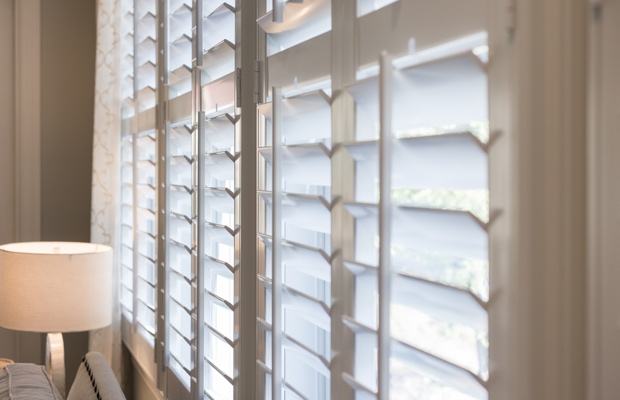
Plantation Shutters with Open Louvers

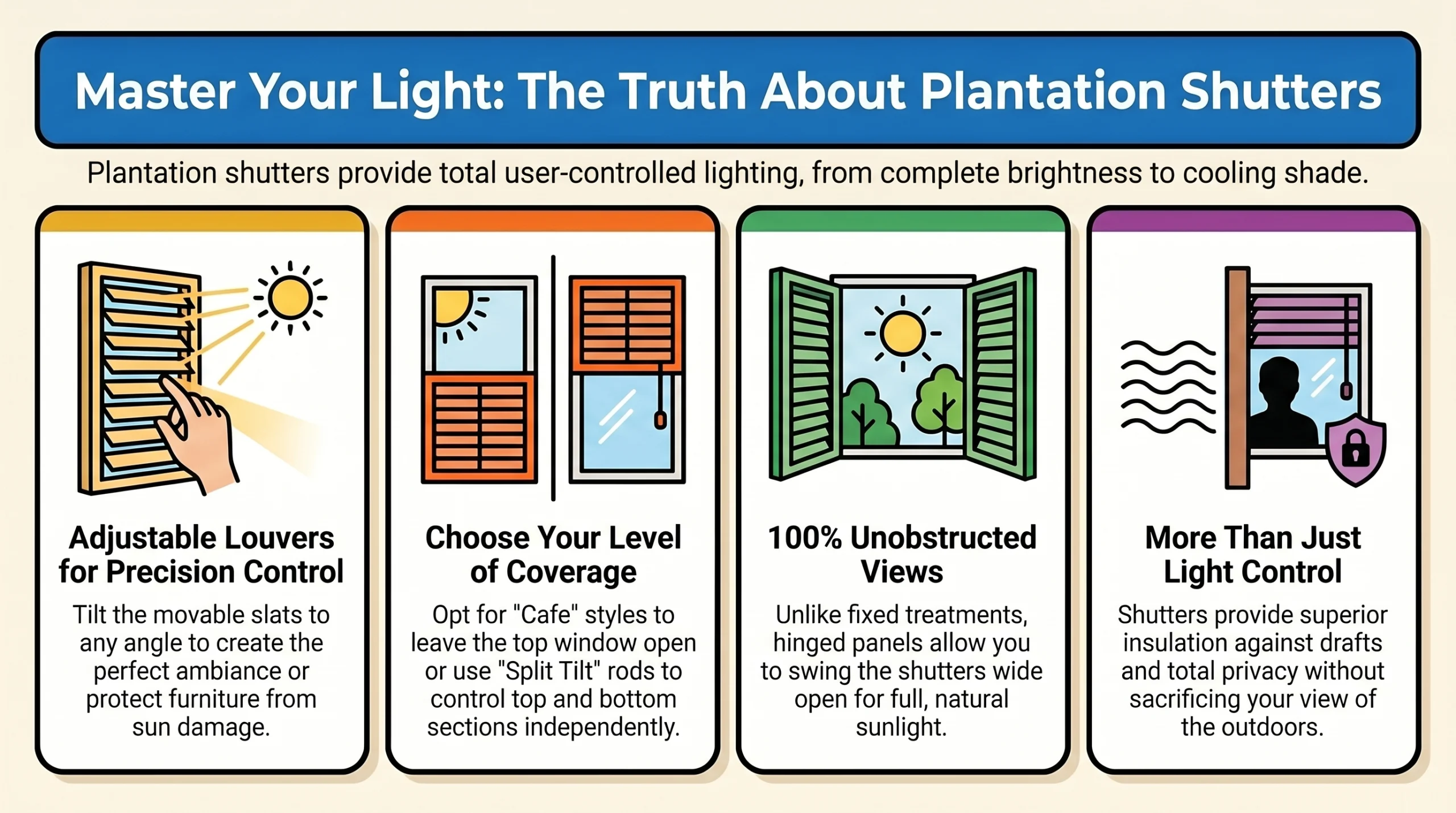
Simply put, plantation shutters can affect the light as much or as little as you want. This is a window treatment that puts you solidly in control.

Certainly, particularly during bright days, you can partially or fully close the louvers to cut down on the amount of light filtering in, therefore limiting the amount of sun damage that your furniture is exposed to and keeping the area cooler.

You can also open the louvers wide and allow the warming light to illuminate your rooms. Open or close the louvers all that you want until you find just the right amount of light to create the perfect ambiance that you’re striving for at any given moment.

Adjustments and Options Mean As Much Sunlight As You’d Like


Not only can the louvers be adjusted for ideal ambiance, but different shutter styles can affect the amount of light that filters through, as well.

When you think of plantation shutters, you likely immediately thinking of our classic, traditional shutters, which cover the entirety of the window from top to bottom. While these are a timeless and stunning choice, there are a variety of other options.

The cafe shutter, for instance, shutters only the bottom section of the window, while the top section remains uncovered, allowing for unobstructed light to beam into your rooms, while still retaining many of the benefits received from traditional plantation shutters. If you’re looking for even more light, perhaps you’d enjoy cafe plantation shutters.

Tilt rods, as well, affect how much control you have over the light filtering into your space. While some plantation shutters use a single tilt rod, there is also the option to have a split tilt rod. This allows for independent control of the top and bottom sections of the shutter.

You may also choose to use a divider rail to have independent functionality of the top and bottom sections. You can open either section as much or as little as you see fit.

What about when you need all of the light you can get? Simply open the panels. Plantation shutters are built with hinges that allow them to be opened fully, allowing for a completely unobstructed window.

Don’t care for the look of hinges around your windows? We have you covered with our patented Softedge™ shutter, which fully conceals the hinges, giving the look a sleeker, more modern appearance.

An Infographic about plantation shutters and light control

Choose Shenandoah Shutters for All of the Light You Need From Plantation Shutters

Shenandoah Shutters has been carefully crafting plantation shutters in Richmond, Virginia for decades. We’re proud to routinely provide expertly designed and customized  plantation shutters to the residents of cities located all over Virginia, Maryland, Delaware, Washington DC, and Northern North Carolina. We’ve even provided plantation shutters outside of our usual region, including states like Florida, Connecticut, and Montana.

Since 1990, we’ve manufactured in our woodshop only our silken, lacquered, wooden plantation shutters; nothing synthetic, artificial, or anything that would take our focus away from this beautiful window treatment. We use the finest American woods available, with the material selected based on the color of your plantation shutters. Basswood, for instance, is used for our stained shutters, while yellow poplar is reserved for our lighter shutters. This allows your color to pair with a wood that allows for the richest, most vibrant hue possible. Prefer a specialty wood or other customization? Let us know.

We pride ourselves on our strong customer service record, grateful and amazed that over two-thirds of our sales are from repeat customers and referrals. We also offer a 100-year limited transferable warranty on your plantation shutters, as well as a 25-year limited warranty on our elegant lacquer finish. We don’t know of any other business that provides this kind of guarantee.

Ready to set-up your free, in-home design consultation? Contact us by web or by phone today. We look forward to showing you how our plantation shutters can provide the exact lighting ambiance that you desire.

Frequently Asked Questions

  • Do plantation shutters block too much light?

No, plantation shutters do not block too much light. They are designed to give you full control, meaning you can let in as much or as little light as you prefer by adjusting the louvers.

  • Can you control how much light enters a room with plantation shutters?

Yes. Plantation shutters feature adjustable louvers that can be tilted to increase or reduce natural light, allowing you to create the ideal ambiance at any time of day.

  • Do plantation shutters help with insulation as well as light? 

Yes. Closing the shutters adds an extra layer of insulation against hot or cold drafts, which can help reduce heating and cooling costs throughout the year.

  • Can you combine plantation shutters with other window treatments?

Yes. If you need complete darkness, plantation shutters can be paired with curtains to enhance light blocking while maintaining their aesthetic appeal.

Home Show Freebies!

Jackie DuVal
June, 2016

As always, we’ll be at the upcoming Richmond Home and Garden show, this October. We always have such a great time at this show! Along with showcasing our shutter display, we get a chance to meet so many people, and catch up with previous customers! Come by and meet our team!

This time, we’re offering a few rounds of free tickets on our Facebook page. Keep your eyes peeled for that, here.

Additionally, the show’s website is offering coupons on tickets. If you’re not one of our winners, take advantage of their offer!

Either way, you’re not going to want to miss the show! It’s at the Richmond International Raceway Complex, October 8 – 9, 2016 (Show Hours: Sat. 10 am – 6 pm Sun. 11 am – 5 pm). So far, over 150 different vendors, companies and crafters have signed up. You will see new inventions, special presentations, trusted names and products, and even a Beer & Wine Garden (Open:
Saturday 12-6pm & Sunday 12-5pm), to benefit, “Wine for Cures.”

As we get closer to the date, more attractions and exhibits will be added. Stay tuned to our web site and Facebook page for more information, and more chances to win!